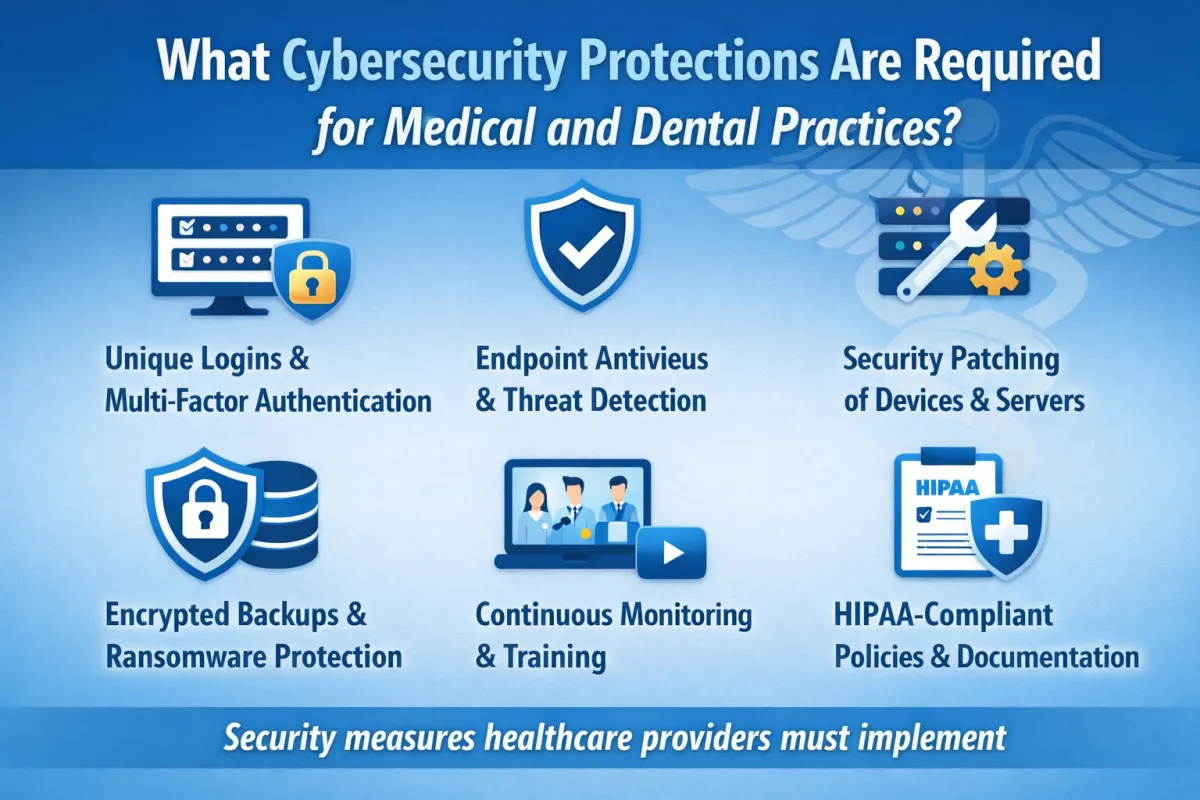
What Cybersecurity Protections Are Required for Medical and Dental Practices?
What Cybersecurity Protections Are Required for Medical and Dental Practices?
Medical and dental practices should have at least seven essential cybersecurity protections in place to protect patient data and meet HIPAA expectations. For practices with 5–15 employees, these protections must be actively monitored and updated. Managed IT services in the $125–$175 per user per month range typically include these safeguards as part of a comprehensive security strategy.
Endpoint Security
All devices accessing patient data must be protected with:
Advanced antivirus or endpoint detection
Automatic updates and patching
Device monitoring and alerts
Unsecured devices are one of the most common breach points.
Secure Access Controls
Cybersecurity begins with controlling access:
Unique user accounts
Role-based permissions
Multi-factor authentication
Secure remote access
These controls prevent unauthorized entry into systems.
Network and Firewall Protection
Network security includes:
Business-grade firewalls
Intrusion detection and prevention
Network segmentation
Secure DNS filtering
This protects systems from external threats.
Email and Phishing Protection
Email is the most common attack vector. Protection includes:
Spam and phishing filtering
Malware scanning
Staff training to identify threats
Most breaches start with a single malicious email.
Backup and Incident Response
Cybersecurity also means being prepared:
Encrypted backups
Regular backup testing
24/7 monitoring
Ransomware response planning
Preparedness minimizes downtime and data loss.
Why Practices Rely on Tryon Computers
Tryon Computers delivers cybersecurity designed specifically for medical and dental environments, with a focus on HIPAA compliance, proactive protection, and local support in the White Mountains, AZ.
